Trivox: Channeling Adrenaline into Your Visual Identity
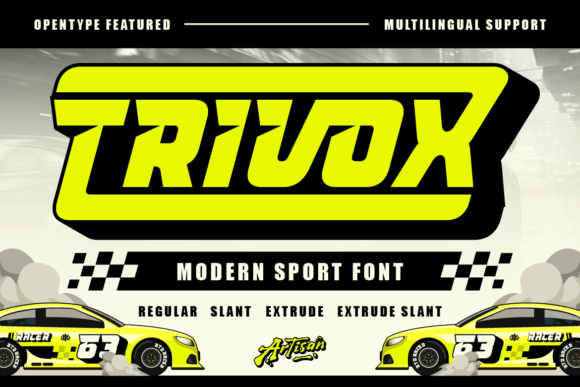
Let’s feel the adrenaline of roaring engines, the blur of neon lights, and the intensity of a high-speed race where every second matters. That split-second rush isn't just for the track; it’s exactly the kind of energy that captures attention in a crowded market. If you’ve ever struggled to convey raw power, futuristic speed, or aggressive modernity in your design work, the solution often lies in the typography. Trivox is born from that very energy. It isn't just another typeface; it is a bold, aggressive modern sport font designed to inject speed, power, and futuristic vibes into your creative projects. Whether you are designing for a local esports tournament, revamping an automotive brand, or creating posters for a high-octane event, understanding how to harness this type of typography is essential for standing out.
The Anatomy of Motion: Why Sharp Angles Matter
Inspired deeply by racing culture, motorsport graphics, and high-performance branding, Trivox features a distinct architectural style. When you look at the letterforms, you don't see soft curves or traditional serifs. Instead, you see sharp angles, strong geometry, and dynamic cuts that instantly create a sense of motion. This is what typographers call a "display font" or a "headline font"—it is built to make an impact at first glance rather than to be used for long blocks of body text.
But why does this matter for your business or project? Visual communication is about immediate emotional response. A rounded, soft font suggests approachability and ease. A font like Trivox, with its stylized alternates and unique structure, suggests dominance and precision. For a brand identity, this is crucial. If you are launching a gym, a tech startup focused on speed, or a racing merchandise line, you need typography that speaks that language before the customer even reads the word. The "visual noise" of the sharp geometry acts as a signal to the viewer that this brand is fast, modern, and authoritative.
Practical Applications: Beyond the Racetrack
While the inspiration comes from motorsport, the application of a high-impact typeface like this goes far beyond racing teams. As a designer or entrepreneur, you need to think about where "impact" is required in your specific niche.
Consider logo design first. A logo needs to be scalable and recognizable. The strong geometry of Trivox ensures that it holds up well when scaled down for a favicon or blown up for a billboard. However, because it is so distinct, it works best for logos where the name is short and punchy. Imagine a cyber-security firm, a delivery service promising "express" shipping, or a modern construction company—these industries value the feeling of solidity and speed.
Then there is packaging design. If you are creating a label for an energy drink, a protein bar, or even a high-end audio tech product, the shelf appeal is everything. Using a premium font with aggressive styling helps differentiate your product from softer, organic competitors. It tells the consumer that the contents are powerful or high-performance. Similarly, in editorial design, such as magazine covers or event programs, a font like this can be used for the masthead or pull quotes to grab the reader's eye immediately.
Digital Dominance: Social Media and Web Design
In the digital realm, attention spans are shorter than ever. You have milliseconds to stop a user from scrolling. This is where a creative font shines. For social media graphics, particularly on platforms like Instagram or TikTok, bold typography is a tool for engagement. Using Trivox for a "Swipe Up" call to action, a sale announcement, or a video thumbnail title can significantly increase click-through rates. It creates a visual hierarchy that demands attention amidst a sea of generic sans-serif fonts.
When it comes to web design, readability is the golden rule, but personality is the brand builder. You wouldn't use an aggressive display font for your "Terms of Service" or your blog body text—that would frustrate your users. However, using it for your H1 headers, your navigation menu, or your hero section buttons creates a cohesive user experience. It sets the mood immediately upon landing on the page. If your website is for a gaming community or a futuristic clothing brand, the typography needs to match that vibe to keep the audience engaged.
Mastering Font Pairings and Readability
One of the biggest mistakes designers make with high-impact fonts is using them everywhere. The rule of contrast applies heavily here. Because Trivox is geometric and aggressive, it pairs beautifully with clean, neutral sans-serif fonts or even classic serif fonts for body copy.
Imagine you are designing a poster for a tech conference. You might use Trivox for the event title—"TECH SUMMIT 2024"—to give it that futuristic energy. For the date, location, and speaker bios, you would switch to a clean, modern sans-serif. This contrast creates a "visual rhythm." The headline grabs them, and the clean text informs them. If you used Trivox for the body text, the design would become illegible and exhausting to read.
When testing your pairings, always check for x-height compatibility. This means ensuring that the lowercase letters of your body font aren't dwarfed by or towering over your headline font. You want a seamless transition from the high-energy headline to the informative body copy. This approach ensures your design assets look professional and are easy to navigate.
Licensing and Long-Term Brand Consistency
When investing in a commercial font, it is vital to understand the licensing. A premium font usually comes with different tiers of licensing depending on usage. If you are a freelance designer creating a logo for a client, you generally need to ensure the client has the appropriate license to use the font on their website and merchandise. If you are a business owner using it for your own brand identity, you need to check if the license covers digital ads, print materials, and embroidery for merchandise.
Using a consistent typeface across all your marketing assets builds brand recognition. When a customer sees your social media post, visits your website, and later receives a printed flyer, the typography should be consistent. This repetition builds trust. It signals that your brand is established and reliable. By incorporating a distinctive font like Trivox into your style guide, you are essentially codifying "energy" and "modernity" into your brand's DNA.
Unleashing the Stylized Alternates
A feature that sets apart truly well-crafted modern typography is the inclusion of alternates and ligatures. Trivox offers stylized alternates that give you flexibility. This means you aren't stuck with one single "A" or "R." You can swap them out to create a more customized look for your headlines.
For example, if you are designing a logo for a racing event, you might want to use a specific alternate of the letter "V" that looks more aerodynamic. Or perhaps you are creating a header for a sci-fi blog and want to connect two letters with a custom ligature to make the word look like a single futuristic symbol. These small details are what separate amateur designs from professional, high-end visual communication. It allows you to create eye-catching visual identities that truly stand out in competitive markets.
Ultimately, choosing a font is about choosing a voice. If your project demands a voice that speaks of speed, power, and the future, the typography you choose must be up to the task. It’s about moving beyond the safe, standard options and embracing type that has a pulse. Whether it’s for a one-off event poster or a complete brand overhaul, matching your visual language to the intensity of your message is the key to making a lasting impact.